Primordial Obliquities of Sun-like Stars and Their Planet-Forming Disks
Stellar obliquity––the angle between a star’s rotation axis and the orbital angular momentum vector of its planets––provides valuable insight into the formation and evolutionary history of exoplanet systems. In Biddle et al. 2025, we investigate obliquity (mis)alignment in 49 single-star systems with planet-forming dust disks that have been well-resolved by ALMA. Combined with new stellar inclination constraints, we find that while most planet-forming systems are aligned, about 30% misaligned. These results contextualize the observed spin-orbit orientations observed in planetary systems, including the Solar System.
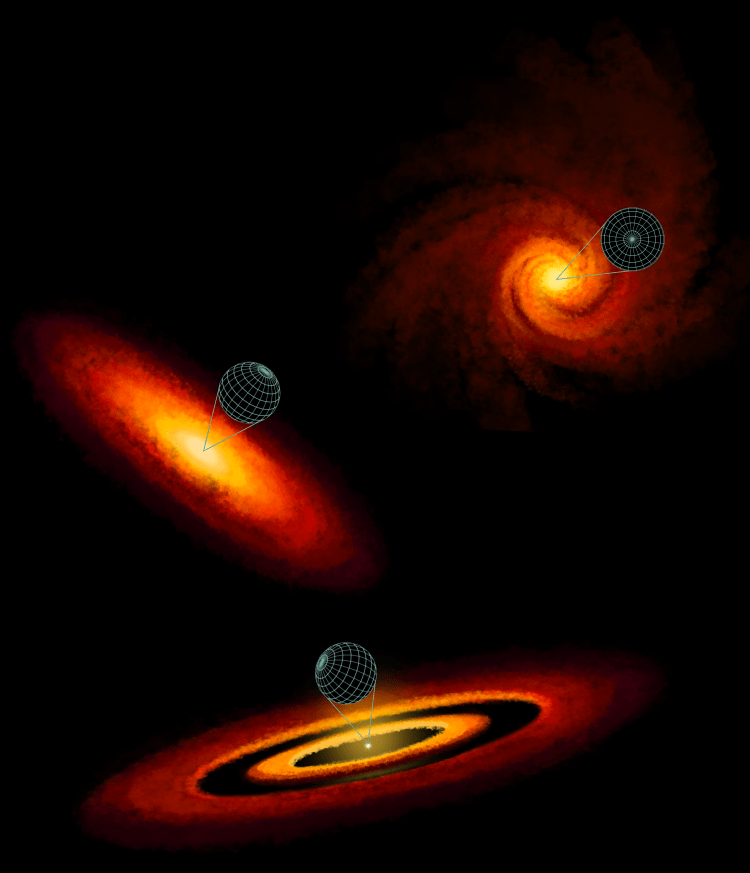
Image Credit: Lauren I. Biddle
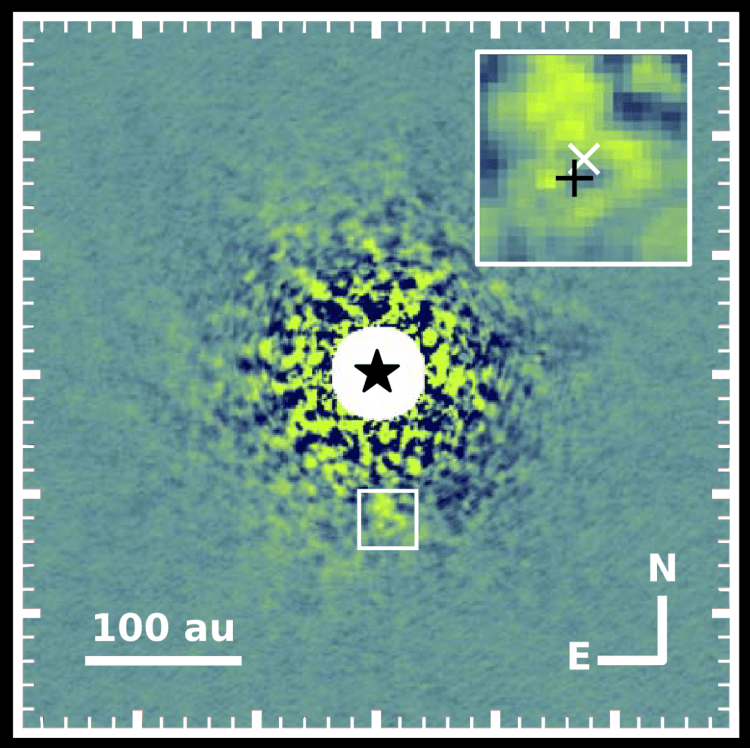
AB Aur b: Accreting Protoplanet
or Compact Disk Feature?
Giant planets form by accreting gas from their surroundings, yet direct observations of this process are rare, leaving major uncertainties in how and where these planets assemble. I lead an investigation to identify the nature of AB Aur b (Biddle et al., 2024), a promising candidate for an actively accreting protoplanet found in the circumstellar transition disk around the young A0 star AB Aurigae. I used high-contrast Paβ imaging with the Keck/NIRC2 to probe Hydrogen emission, a tracer of accretion.
Photometric Time Series Accretion Diagnostics
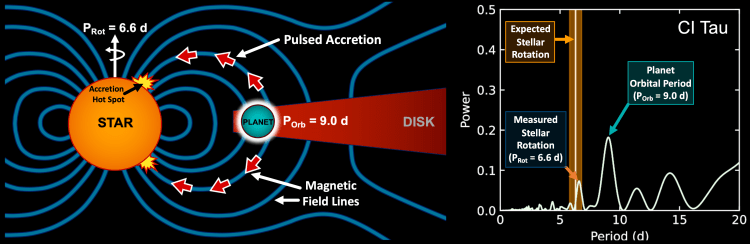
I published additional work linking the origin of the large- and small-scale variability sources in CI Tau’s lightcurve in Biddle et al. (2021). To understand the entire nature of the variability in CI Tau’s K2 lightcurve, I isolated the stochastic small-amplitude variations occurring on timescales of ≲1 d. I searched for time-dependent changes in the amplitude of these variations, and found that it is periodic on the same timescale as the long-term variability analyzed in Biddle et al. (2018), presenting direct evidence that the physical mechanism modulating these brightness features is the same.

The Planet-Star Connection
In Biddle et al. (2018), I present the first detection of planet-driven pulsed accretion onto a star, introducing a unique method for finding close-in planets around young stars with protoplanetary disks. The basis of such a detection relies on the interaction between a close-in planet and accreting disk material. As the planet moves through the disk, it will cause density perturbations in nearby disk material, altering the rate of accretion onto the star. The resulting brightness of the hot spot at the base of the accretion stream will vary periodically on the timescale of the planet’s orbit.
Transit Spectroscopy of
GJ 3470 b
As an undergraduate, I lead a team of 21 researchers from 12 institutions in an a worldwide effort to characterize the atmosphere and physical and dynamical properties of the warm-Neptune GJ 3470b (Biddle et al. 2014). I coordinated a team of scientists through remote communications, and I managed the development of the written paper to completion.

The program delivered the largest set of homogeneously analyzed transits of GJ 3470b at the time, producing an updated transmission spectrum that reinforced the existence of an H2-dominated atmosphere and a strong Rayleigh scattering slope. This work also yielded most precise measurement of the planet radius at the time, as well as an updated limit on the planet mass and an improved orbital ephemeris. Results also included refined measurements of the host star’s temperature, mass, radius, metallicity, logg, and rotation, crucial to know thy star. How well we can characterize a planet is limited by how well we know the star, driving the argument that stellar characterization campaigns should be a priority in the field of exoplanets.
 Lauren I. Biddle